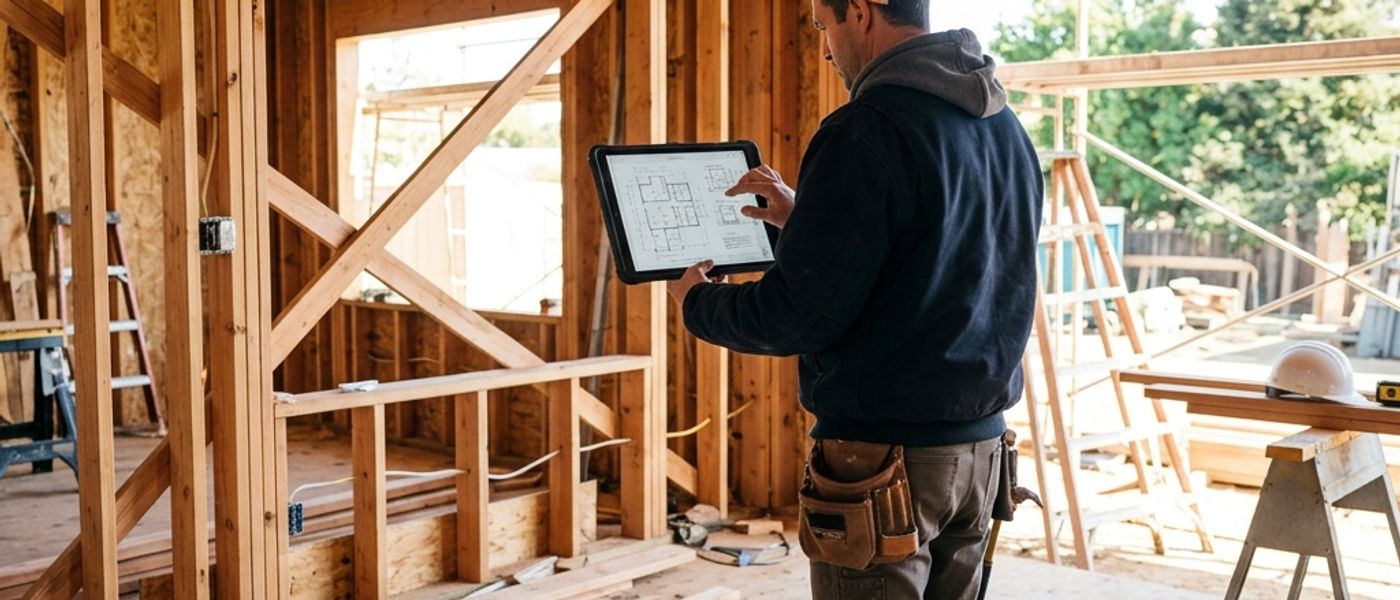
"I can run a 200-person engineering org but I can't get a straight answer from a contractor about what my kitchen will cost."
A homeowner in Menlo Park said that to us recently. She is not alone. The people hiring contractors for $500,000 to $2 million remodels in Hillsborough, Atherton, Burlingame, and Los Altos are among the sharpest decision-makers in the Bay Area. They run companies. They negotiate complex deals. And yet, when it comes to hiring a general contractor, most of them feel like they are guessing.
That is not because they are uninformed. It is because the standard advice does not go deep enough, and because the stakes of getting it wrong are not recoverable once construction starts.
Table of Contents
- The Checklist Everyone Gives You (And Why It Is Not Enough)
- Who Is Actually Running Your Job?
- How Long Has the Crew Been Together?
- The 7 Questions That Reveal How a Contractor Actually Operates
- The Red Flags That Should End the Conversation
- What Premium Builders Do Differently
- FAQ: Hiring a General Contractor on the Peninsula
The Checklist Everyone Gives You (And Why It Is Not Enough)
You have seen the list. Every home improvement site publishes some version of it:
- Verify the contractor's license on the California CSLB website
- Confirm they carry general liability and workers' compensation insurance
- Read reviews on Google and Yelp
- Ask for references and call them
- Get at least three bids
Do all of this. But here is the problem: at the $500K+ level, every contractor on your shortlist will check these boxes. They will be licensed. They will be insured. They will have positive reviews and references who say nice things. That is table stakes, not a decision framework.
The real question is not "is this contractor legitimate?" It is "is this contractor right for my project, at this scale, for the next 12 to 18 months?"
Because once you start, you cannot fire the contractor halfway through and start over without massive cost and time penalties. You are committed. The criteria that actually predict success or failure are not on any standard checklist.
One starting point that does matter: look up the CSLB license directly at cslb.ca.gov. For reference, Tabel Construction holds License B-831477 (General Building Contractor) and License C-27 (Landscaping), both active and in good standing. Any contractor you seriously consider should hold the correct license classifications for the scope of your project. Verify there are no complaints or disciplinary actions on record, it takes 90 seconds and the information is public.
What follows are the things that separate a builder you will regret from a builder you will refer.
Who Is Actually Running Your Job?
This is the single most important question in the hiring process, and most homeowners never think to ask it: "Will you, the owner, be on my project?"
Here is what commonly happens. The owner shows up for the initial meeting. He is knowledgeable, personable, confident. He walks your house, talks about your vision, and you think: this is the person I want. Then you sign the contract. On Day 1, a project manager you have never met shows up with a clipboard. The owner is at a sales meeting for his next project.
This is the bait-and-switch of residential construction. It is not illegal. It is not even unusual. But on a $500,000+ remodel, where decisions need to be made in real time about structural issues, material substitutions, design conflicts, and unexpected conditions, the person on site needs both the knowledge and the authority to handle them. A project manager calling the owner for approval on every question slows the job, introduces miscommunication, and costs you money.
There is a meaningful difference between an owner-operator who can do every trade himself, someone who started as a finish carpenter, who understands framing and plumbing and electrical at a trade level, and an owner who built a company and manages from a desk. Both can run successful businesses. But on your project, the person standing in your house making real-time decisions with hands-on knowledge is a fundamentally different experience.
If a contractor tells you "my project manager will be your main point of contact," ask follow-up questions. Who is that person? How long have they been with the company? What authority do they have to make decisions without calling the owner? The answers will tell you how your project will actually be run.
One homeowner summed up the moment of clarity: "Wait, the owner is actually on the job? Like, physically there? That changes everything."
It does. On projects in Hillsborough, Atherton, Woodside, and Los Altos Hills, where the complexity, the community visibility, and the financial stakes demand daily accountable leadership, owner presence is not a luxury. It is the baseline.
How Long Has the Crew Been Together?
Crew stability is one of the most reliable indicators of how a contractor actually operates, and one of the least discussed.
A builder who has kept the same core crew for 15 years or more is running a fundamentally different operation than one with constant turnover. Long-tenured crews know the builder's standards without being told. They anticipate problems. They hold each other accountable. The work is consistent from project to project because the people doing the work are consistent.
For you as a homeowner, this matters in a practical way: the people in your home for the next 12 months should be known, vetted, and accountable, not a rotating cast of strangers. You should be able to learn their names. They should know your project, your preferences, and your home.
Ask your contractor directly: "Who are the people who will be on my job site every day? How long have they worked with you?"
Then ask about subcontractors: "Do you use the same subs on every project? How long have you worked with them?" A builder who has used the same electrician, plumber, and HVAC contractor for a decade has a team that functions as a coordinated unit. A builder who subs out to whoever is available that week has a pickup game, and pickup games do not build $1.5 million kitchens to spec.
Red flag: vague answers about "our network of skilled tradespeople" instead of specific names and years of tenure. If they cannot name their crew, they do not really have one.
The 7 Questions That Reveal How a Contractor Actually Operates
Every contractor sounds the same during the sales pitch. "We communicate." "We are on time and on budget." "We are different." Then they are not. These seven questions are designed to cut through the pitch and reveal operational reality.
1. "What does your bid include, and what does it NOT include?"
This forces specificity. A contractor who has actually priced your project answers without hesitation: permits are included, engineering is included, here is the contingency line, here is what is excluded and why. A contractor who wings the answer is winging the bid. On a major Peninsula remodel where permits and engineering alone can run $15,000 to $50,000, vagueness here is not a stylistic difference. It is a financial risk.
2. "How do you handle change orders?"
Change orders happen on every project. What matters is the process. Is there a written change order with scope, cost, and timeline impact before any additional work begins? Or does the contractor do the work and present the invoice later? Ask to see their written change order policy. If they do not have one, that tells you everything.
3. "How do you communicate during the project, and how often?"
Look for a structured cadence: weekly updates, a regular check-in format, a defined communication channel. "We are always available" sounds reassuring but means nothing. Proactive communication, where you hear about what is coming before it is urgent, is fundamentally different from reactive communication, where you only hear about problems after they have become emergencies. A builder who delivers solutions alongside problems is the operational standard you are looking for.
4. "What happens when you find something unexpected behind the walls?"
Every remodel has surprises. The question tests whether your contractor arrives with problems or with solutions. The answer you want: "We assess the situation, develop two or three options with different cost and timeline implications, and present them to you before we proceed." The answer you do not want: a long pause followed by "we will figure it out."
5. "Can I see a project you have in progress right now?"
A finished portfolio shows the best version of the work. An active job site shows how the work actually gets done. Walk it with them. Is it clean and organized? Are materials staged neatly? Is there protection on the existing floors and surfaces? Is there a dumpster on site, or is debris piling up?
A clean, organized job site tells you more about a contractor's standards than any showroom. The City of Los Altos once contacted a Peninsula builder specifically to commend their job site cleanliness, the building inspector reported it to the chief building official. That is a signal. That is the standard.
6. "What is the hardest project you have completed, and what went wrong?"
Every experienced builder has war stories. A hillside foundation that shifted. A 1920s home with no straight walls. A permit process in Palo Alto that took twice as long as planned. Honest contractors tell these stories without being asked, because the hard stuff is what proves their capability. If a contractor tells you everything always goes smoothly, they either have not done enough complex work or they are not being straight with you.
7. "Why should I hire you over the other two contractors I am considering?"
Listen carefully to the answer. A confident builder talks about their process, their team, their approach to communication and problem-solving. Specificity is the signal. "Because I will be on your job site every day and I can explain every line in your bid" is a different answer than "because we deliver quality results."
Most Peninsula homeowners tell us the first conversation with us felt different, not because we said different things, but because we could explain specifically what we would do and why. If you are in the middle of evaluating contractors and want a benchmark conversation, call or text Matt at (408) 448-1342. No commitment, no pressure.
The Red Flags That Should End the Conversation
Not every warning sign requires nuance. Some should stop the process immediately.
Refuses to provide an itemized bid. A one-page estimate with round numbers for a $500,000+ project is not a bid. It is a guess, and it is the opening move of a contractor who plans to recover the difference through change orders. In 2026, Peninsula remodel costs run $350 to $700+ per square foot. Any bid that does not show you where those numbers come from is not a bid.
Cannot explain price differences. If you bring competing bids and the contractor cannot walk you through why their number differs from the others, they did not price the work themselves. They plugged numbers into a template or had a salesperson generate the quote.
Pressures you to sign quickly. "This price is only good for 30 days" on a major remodel is a sales tactic, not a business reality. A contractor who pressures you to sign before you are ready is more concerned with closing the sale than earning your confidence.
No references from projects of similar scope. A contractor who does excellent bathroom remodels might be overwhelmed by a whole-house renovation. Scale matters. Ask for references specifically from projects that match yours in size, complexity, and budget.
The owner will not commit to being on your project. "I oversee all our projects" is not the same as "I will be on your job site." Press for a specific answer. If the owner is splitting time across five projects, you are getting 20 percent of their attention on a project that requires full engagement.
Vague timeline with no milestones. "About 10 to 12 months" without a phased schedule, demolition, rough-in, inspections, drywall, finishes, punch list, is not a timeline. It is a guess dressed up as a plan.
Bad-mouths competitors. The confident builder explains what they do. The insecure builder explains what others do not. If a contractor spends the conversation tearing down the competition instead of demonstrating their own capability, that is a character signal, not a sales technique.
What Premium Builders Do Differently
This is not about a specific company. It is about what the best builders on the Peninsula have in common, the patterns that show up consistently in contractors who deliver successful projects at this scale.
They show you where every dollar goes. Not a lump sum with a smile and a handshake, but a line-item proposal where every trade, every material, every fee, and every contingency is visible and explained. Clients bring competitor bids and the best builders can explain the differences line by line, not by criticizing the other contractor, but by pointing to specific inclusions.
They tell you what is going to be hard about your project before you sign. Not after. An honest builder who sees potential complications, soil conditions on a Woodside hillside lot, permit complexity in Palo Alto, structural unknowns in a 1960s Burlingame ranch, flags them during the bid process. Not as a surprise during construction.
They have structured processes for the moments that matter. Like walking you through the framing before the drywall goes up, giving you one last chance to verify outlet placement, plumbing locations, and blocking before it disappears behind the walls. These are the checkpoints that prevent expensive mistakes. Builders who skip them are building fast, not building right.
They communicate proactively. You hear about problems with solutions already attached, not as emergencies, but as decisions to make together. The communication cadence is consistent and structured, not sporadic and reactive.
They limit the number of projects they take. Not to create artificial scarcity, but because the principal needs to be present, and there are only so many hours in a day. A builder who takes on three projects at a time so the owner can be on each one daily is a different business model than one who takes on fifteen and dispatches project managers to each.
They have a documented track record on the Peninsula. Twenty-plus years of projects in Hillsborough, Atherton, Burlingame, Menlo Park, Los Altos, and surrounding communities is not a marketing claim. It is a body of work you can visit, reference clients you can call, and a license record you can verify.
The right contractor for a major remodel is not the one with the best pitch. It is the one whose process makes you feel informed, not anxious. Whose answers make you feel more confident, not more confused. Whose presence on the job makes you trust that what is happening behind the walls is as careful as what you see on the surface.
"What scares me is what I do not know to ask about." We hear that from Peninsula homeowners in Atherton, Portola Valley, and Los Altos Hills regularly. The answer is: a good contractor fills those gaps for you, before you have to discover them the hard way.
Credentials worth checking before any major hire: an active contractor license (Tabel's is B-831477, which anyone can look up on the California Contractors State License Board website) and an unbroken 20+ year referral record on the Peninsula.
If you are planning a major remodel, a full gut, a structural addition, a hillside build, or anything that feels complex, we are happy to answer the questions this article raised, and a few you have not thought to ask yet. If you are in Hillsborough, Atherton, Palo Alto, Menlo Park, Los Altos, Woodside, Portola Valley, or anywhere on the Peninsula, reach out to Margie at info@tabelconstruction.com or call Matt at (408) 448-1342. Even if you are not planning to hire us, the conversation is yours.
Already have bids in hand? Read our companion post: How to Compare Contractor Bids Without Getting Burned, it breaks down what should be in a bid, what is usually missing, and how to read them like a builder.
Planning to go deeper into the construction process? Read: Why the Pre-Drywall Walkthrough Is the Most Important Day of Your Remodel, it explains the single quality checkpoint that separates transparent builders from everyone else.
FAQ: Hiring a General Contractor on the Peninsula
Q: How do I know if a general contractor will actually be on my job site, or if they will hand it off to a project manager?
Ask directly: "Will you, the owner, be on my project every day?" Then ask specifically what that means. How many projects are they running simultaneously? Who makes real-time decisions when you are not there? A contractor who sends a project manager to your $1.2 million remodel is running a different business than one whose owner is on site daily. The distinction matters most when something unexpected happens behind the walls, which it will.
Q: What makes a general contractor right for a major remodel versus a smaller renovation?
Scale and complexity change everything. A contractor who does excellent bathroom remodels may be overwhelmed by a whole-house renovation requiring structural engineering, multiple permit types, and coordination of seven or eight trades simultaneously. Ask for references specifically from projects matching your scope and budget. Ask about their hardest completed project. Ask how many projects of this size they are currently running. The answers reveal whether their operation scales to your project, or whether yours would be their biggest job to date.
Q: How long should a major remodel take on the Peninsula, and what affects the timeline?
For a full home remodel in the $750,000 to $2 million range, typical timelines on the Peninsula run 10 to 18 months from permit approval to completion. Factors that affect timeline: permit processing in the specific municipality (Palo Alto and Hillsborough tend to run longer than San Jose or unincorporated Santa Clara County), structural complexity, scope changes during construction, and whether the contractor has a realistic phased schedule or a vague general estimate. Any bid that does not include a phased milestone schedule, demolition, rough-in, inspections, drywall, finishes, punch list, is not a plan.
Q: How do I evaluate contractor reviews when I know they can be manipulated?
Read the negative reviews first. How many are there? What do they say? How did the contractor respond? A contractor with zero negative reviews across Google and Yelp over 20 years of work has either managed their reviews very carefully or has a genuinely excellent track record, and the platforms themselves can often tell you which. Yelp is harder for contractors to manipulate than some review platforms because Yelp does not allow contractors to suppress reviews by paying. Cross-reference with CSLB complaint history. Ask your architect or designer who they trust, their referral is worth more than any aggregated star rating.
Q: What is the difference between a general contractor who does luxury remodels and one who specializes in complex or challenging projects?
A luxury-focused contractor excels at high-end finishes, material sourcing, and aesthetic execution. A contractor who specializes in complex projects, hillside foundations, seismic retrofits, structural additions on older homes, challenging lots in Portola Valley or Woodside, brings a different kind of expertise: the ability to anticipate and solve problems before they become emergencies. The Peninsula's older housing stock and challenging terrain mean that complexity is the norm, not the exception. Ask specifically about the hardest site condition the contractor has managed, and what their approach was.
Q: Does Tabel Construction do the pre-drywall walkthrough as a standard part of their process?
Yes. The pre-drywall walkthrough is a signature part of how Tabel builds. Before drywall is installed, the builder pauses construction and walks the homeowner, and any architect or designer on the project, through every room: outlet placement, switch locations, plumbing routing, HVAC registers, structural connections, and all blocking locations. Matt Tabel calls it "last call for wires in the walls." It is the moment where everything behind the walls is still visible and changeable. After drywall, the same changes cost ten times what they cost now.