Table of Contents
Why This Matters on the Peninsula
A major remodel in Hillsborough, Atherton, or Burlingame typically runs $350 to $700 per square foot, and whole-home renovations regularly reach $500,000 to $2 million. At that scale, a vague bid is not just a paperwork inconvenience. It is the document you will hold someone to when things go sideways at month four.
"Our goal isn't to be the cheapest or the highest," Margie Tabel says. "It's to be the most accurate." That word, accurate, is the right standard for any proposal you evaluate.
Here are the seven most common warning signs that a bid will not hold up.
Red Flag 1: A Lump-Sum Estimate With No Breakdown
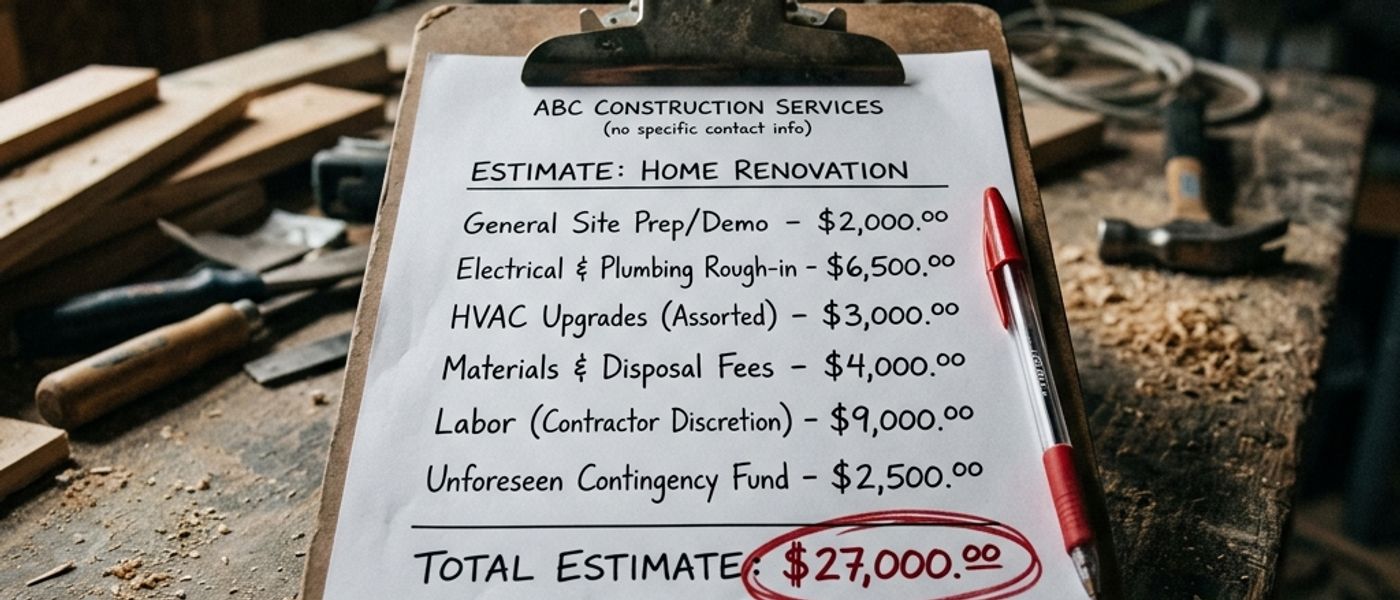
If a contractor's proposal reads "Complete kitchen remodel: $185,000" with nothing underneath, that is not a bid. It is a number.
You cannot verify a number. You cannot compare it to another contractor's proposal. You cannot tell what is included, what is excluded, or what assumptions were made. And when something changes mid-project, and it will, you have no baseline to work from.
The lump-sum format benefits the contractor, not the homeowner. It gives them flexibility to adjust interpretation later. "Oh, that didn't include the island seating area." "The tile allowance we assumed was for standard 12x12, not the large-format porcelain you selected." If it was not itemized going in, you cannot push back when it appears on your invoice.
Legitimate contractors break it down. Not because they are required to, but because they want you to understand what you are buying. A detailed proposal is also how a contractor demonstrates they have actually thought through your project, not just thrown a number at it.
What to look for instead: A proposal organized by trade or phase, with separate line items for demo, framing, plumbing, electrical, HVAC, finish materials, labor, and anticipated allowances. It should be detailed enough that you could hand it to a second contractor and ask, "Is this included in your bid too?"
Red Flag 2: An Unusually Low Price
The lowest bid is rarely the safest bet. Most experienced homeowners know this intuitively. They underestimate how systematic the problem is.
There are two reasons a contractor comes in significantly below the others. The first is omission: they left something out, either because they did not read the scope carefully, used a low allowance they know will not cover the real cost, or deliberately stripped the bid to look competitive. The second is strategy: they plan to win the job at a low number and recover their margin through change orders once you are committed and cannot easily walk away.
This is the construction industry's worst-kept secret. A contractor prices aggressively to win the job. Demo begins. Three weeks in, they discover "unforeseen conditions" that any experienced builder working on a 40-year-old Peninsula home should have anticipated. Now you are 30 percent into a project you cannot stop, and the budget is already moving.
A bid that is 20 to 25 percent below two other careful proposals almost always means something is missing. The question is whether you find out before you sign or after demo begins.
What to look for instead: A competitive bid, not a suspiciously low one. Ask the contractor to walk you through their allowance assumptions, especially for items with wide price ranges: cabinetry, tile, plumbing fixtures, lighting, and appliances. If their allowances are significantly below what you actually want, the final cost will not look like the bid number.
If you are in the middle of evaluating bids right now and want a second set of eyes on the documents, reach out to our team. We will walk you through what you are looking at, even if you end up hiring someone else.
Red Flag 3: No Mention of Permits
Some contractors suggest skipping permits to save money and time. On the Peninsula, this is not a shortcut. It is a liability that follows your property indefinitely.
Unpermitted work creates three distinct problems.
First, it voids homeowner's insurance coverage for anything related to that work. If a fire starts in an unpermitted electrical panel upgrade, your carrier has grounds to deny the claim.
Second, it creates a title problem. When you sell, disclosure requirements mean you have to identify unpermitted work, which typically triggers either a costly retroactive permit (sometimes requiring you to open walls) or a price reduction that far exceeds what you saved.
Third, in communities like Hillsborough, Atherton, Burlingame, and Palo Alto, building departments actively enforce permit requirements. If work is discovered without a permit, you can be ordered to expose it for inspection or, in some cases, to remove it entirely.
The permit process also serves a practical function: it puts a licensed inspector on your project at key stages. Framing, plumbing rough-in, electrical rough-in, insulation. An experienced building department inspector is not just checking boxes. They are catching things.
A contractor who suggests skipping permits is either cutting corners on their own licensing obligations or has had compliance problems in the past. Neither belongs on your project.
What to look for instead: A contractor who names the specific permits required for your scope and includes permit fees as a line item. They should know your city's inspection timeline and be able to explain how it affects your project schedule.
Red Flag 4: Vague Scope Language
Read the scope section of every bid carefully. Then read it again.
Here is what vague scope language looks like: "Kitchen remodel includes demo, new cabinets, counters, and appliances." That sentence sounds complete. It is not. It says nothing about:
- Cabinet brand, construction type (custom, semi-custom, or stock), or installer
- Counter material and edge profile
- Who supplies the sink, faucet, and hardware, and at what price point
- Tile: floor, backsplash, or both? Who selects? What is the allowance?
- Appliance brand, delivery, and installation
- New electrical circuits for appliances
- Plumbing for a relocated sink or island connections
- Lighting: recessed, under-cabinet, pendant rough-in
Every one of those items is a future change order waiting to be written.
Vague language is not always intentional dishonesty. Sometimes it reflects a contractor who has not thought through the full scope. The result is the same either way: you sign a contract for something that is not clearly defined, and ambiguity always resolves in the contractor's favor.
"We include what others leave out," Matt Tabel says, not as a marketing line, but as an explanation of why his proposals run longer than most. Every item that could be interpreted two ways gets spelled out one way. In writing.
What to look for instead: Scope language specific enough that there is no reasonable ambiguity about what is included. Allowances stated as dollar amounts, not vague descriptions. If a contractor cannot define the scope with that level of specificity during bidding, they will not suddenly become more specific when a conflict arises on site.
Red Flag 5: No Clear Change Order Process
Every construction project has changes. A wall comes open and the plumbing is not where the plan assumed. You see the framing and decide you want the window moved eight inches. A fixture gets discontinued and needs a substitution. This is normal. It is not a sign of a bad contractor.
The question is not whether changes will happen. The question is how they are handled when they do.
A contractor who waves off the question with "we'll figure it out as we go" or "we just do a quick email" is describing a process that protects them, not you. Verbal change orders are unenforceable. On a $750,000 project, "we'll figure it out" can mean a $40,000 dispute at the end of the job.
A contractor with a professional change order process can describe it clearly before you ask: written documentation of every scope change, a cost estimate before work begins, your written approval before anyone lifts a tool. A paper trail that keeps the project financially transparent from start to finish.
What to look for instead: A contractor who describes their change order process in specific terms, shows you a sample form, and explains their approval thresholds. The best contractors price change order work with the same transparency as the original bid.
Red Flag 6: Pressure to Sign Before You Are Ready
A high-pressure close during the proposal phase is one of the clearest signals that something is off.
You will encounter this in a few forms. "We have another project that starts in two weeks, if you want to hold your spot, I need a deposit by Friday." "I can only hold this price until the end of the month." "We're getting a lot of inquiries on projects like yours."
A contractor who has been doing good work for 20-plus years on the Peninsula does not need to manufacture urgency. Their schedule fills because their work speaks for itself. They are willing to give you the time you need to evaluate the proposal carefully, because they want clients who have chosen them with a clear head.
Artificial deadlines are a sales tactic used by contractors who know their bid will not hold up to careful scrutiny. The pressure is designed to get your signature before you have asked the questions that would reveal the problems.
What to look for instead: A contractor who says "take the time you need" and means it. One who follows up with additional information, not with a deadline. The right contractor for a $500K-plus project is the one who treats your decision with the same care they will eventually bring to your home.
Red Flag 7: The Owner Will Not Be On Site
This is the most important question most homeowners do not think to ask until it is too late.
During the pitch, you meet the owner. He is knowledgeable, attentive, and clearly understands your project. Then the contract is signed, and you discover he has five other projects running. A project manager named Danny will be your day-to-day contact. The owner "checks in regularly."
What you purchased in the pitch is not what is being delivered on your job.
When the owner of a construction company is personally on your project, the accountability structure is fundamentally different. The person who made the promise is the person ensuring it is kept. There is no "I'll check with the boss" because the boss is standing in your kitchen when the problem surfaces. Problems get solved, not reported upward.
"His name is on the company," Margie Tabel says. "We want to make sure we get it right." That is not a tagline. It is a description of an accountability structure.
At the scale of a $500,000 to $2 million Peninsula renovation, the owner's presence on-site is not a luxury. It is the mechanism that ensures the standards promised in the bid are the standards delivered on the job.
What to look for instead: Ask directly: "Will you be personally on site throughout the project, or will it be managed by a project manager?" Listen to the answer and notice how quickly they give it. An owner-operated company answers this question immediately and specifically.
What a Legitimate Bid Actually Looks Like
A well-constructed proposal does three things at once. It tells you what you are buying. It tells you what is not included. And it gives you enough detail to compare it honestly against another bid on the same scope.
When you receive a bid that meets that standard, you can sit down with a second contractor and ask: "Their proposal includes this. Does yours?" That conversation is where the real comparison happens. Most homeowners never get there because their proposals are not detailed enough to support it.
"You can't compare apples to apples when you don't know what someone is bidding," Margie Tabel says. That is why a legitimate proposal on a major Peninsula renovation should include:
- A line-item breakdown by trade and phase
- Specific allowance amounts for variable materials
- Permit fees listed as a line item (by city, by your scope)
- A written change order process with a sample form
- The owner's direct contact information and expected on-site schedule
- A project timeline with plan check windows factored in
If a bid you are looking at includes all of that, you are working with someone who has thought through your project. If it is missing three or four of those things, you now know what questions to ask before you sign anything.
How to Use This Framework
Bring this list to every bid review conversation. Ask each contractor to walk you through their change order process. Ask what their countertop allowance assumes. Ask whether permits are included and which city's fee schedule they used. Ask what happens if demo reveals something unexpected.
The answers tell you more than the bottom-line number ever will.
A contractor who has done this work for 20-plus years on complex homes in Peninsula communities will answer those questions without hesitation. They have thought through all of it already, because building at this level requires it.
If a contractor seems caught off guard by the question, that is useful information too.
If you are planning a major renovation in Hillsborough, Atherton, Burlingame, Menlo Park, Los Altos, or Palo Alto and want to talk through what you are seeing in your bids, we are glad to walk through them with you. There is no obligation, and the conversation will leave you better equipped regardless of who you hire.
Reach Matt directly at (408) 448-1342 or email info@tabelconstruction.com.
Frequently Asked Questions
Q: How detailed should a contractor bid be for a major kitchen remodel?
A legitimate proposal for a major kitchen remodel should break down costs by trade: demo, framing, plumbing, electrical, HVAC, cabinetry, countertops, tile, lighting, appliances, and finish work. Allowances for variable materials should be stated as dollar amounts, not descriptions. A complete bid for a kitchen remodel in Hillsborough or Burlingame costing $150,000 to $350,000 should typically run eight to twenty pages, depending on scope.
Q: Why do contractors give such different bid prices for the same project?
The most common reason is scope variation, not price difference. One contractor may include permit fees, appliance delivery, electrical upgrades, and debris removal while another only includes rough framing and cabinet installation. Before comparing numbers, ask each contractor to confirm what is included in writing. You cannot evaluate price until you know the scope is identical.
Q: Is it ever safe to hire the lowest bidder on a renovation?
It depends on why the bid is low. If the proposal is detailed and the contractor can explain every line item, a lower price may reflect legitimate efficiency. More often, a significantly lower bid reflects omitted scope or unrealistically low allowances. Ask the low bidder to walk you through their assumptions on allowances for cabinetry, tile, and fixtures. If their allowances are significantly below what you actually want, the final cost will be higher than the bid.
Q: What is a reasonable contingency budget for a major Peninsula renovation?
Most experienced contractors and architects recommend 10 to 20 percent contingency on top of the contract price for projects in older Peninsula homes. Hillsborough, Atherton, and Burlingame have significant housing stock from the 1950s through 1980s, and opening walls in older homes frequently reveals plumbing, electrical, or structural conditions that require attention. A contractor who has worked extensively in these cities will have realistic expectations about what demo typically reveals.
Q: Should the contractor or the homeowner pull permits?
The licensed contractor must be named on the permit in California, this is a legal requirement. If a contractor suggests you pull permits yourself as the owner-builder to reduce costs, that is a significant red flag. Owner-builder permits create personal liability and insurance gaps that most homeowners do not fully understand. The contractor's license is their bond of professional responsibility. They should own the permit.
Q: How do I know if a contractor's crew will actually be the people on my job?
Ask directly: "Will the subcontractors you use on my project be the same ones you used on your last comparable project?" Then ask how long they have worked with their main trades. A contractor who has used the same plumbing crew for eight years and the same electrician for twelve has built something real. Vague answers about a "strong network" describe availability, not continuity.
Tabel Construction and Design is a third-generation general contractor specializing in complex residential projects on the San Francisco Peninsula. License B-831477 (General Building Contractor). For questions about evaluating contractor bids, reach the Tabel team at info@tabelconstruction.com or (408) 448-1342.